
Baby Sleep Schedule by Age (0–12 Months): The Rhythm That Helps Babies Sleep Longer

If your baby’s sleep feels unpredictable, it’s usually not random.
It’s a missing rhythm.
Most babies don’t need more sleep tips.
They need a day that actually supports sleep.
When your baby’s sleep, feeding, and wake windows start working together, nights often improve quickly.
In many cases, that leads to longer stretches and eventually 12 hours of night sleep.
If you’re searching for a baby sleep schedule by age, this guide will show you what’s actually happening and how to build a rhythm that works.
What You’ll Learn
In this guide, you’ll learn:
- how to build a baby sleep schedule that actually works
- the wake windows that prevent overtiredness
- why short naps and night waking happen
- how to structure your baby’s day for longer sleep
- what it takes to reach consistent 12 hour nights
Why Babies Need a Sleep Schedule
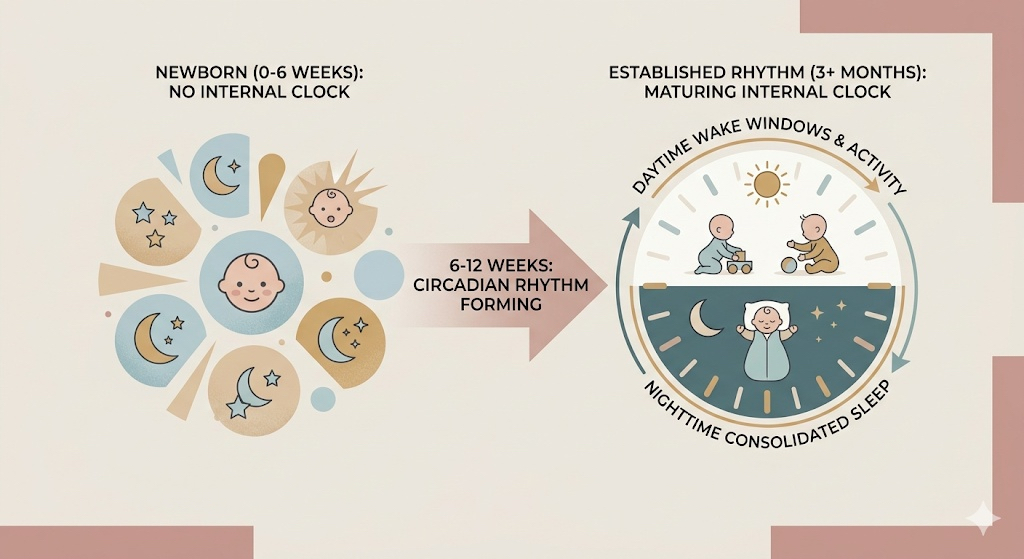
Without structure, baby sleep stays unpredictable.
Babies are not born with an internal clock.
In the beginning they sleep in short bursts around the clock because their circadian rhythm hasn’t developed yet.
Circadian rhythm begins forming around 6–8 weeks and becomes more established by about 12 weeks.
During that time several things are happening inside your baby’s body:
- sleep cycles are maturing
- daytime wake windows gradually lengthen
- night sleep consolidates
- the number of naps decreases
Over the course of the first year, many babies naturally shift toward longer nighttime sleep and fewer daytime naps as their nervous system continues to mature, especially when their sleep is supported by a consistent daily rhythm.
Without that support, sleep can remain fragmented well beyond the baby stage, which is why many families still struggle with night waking even with toddlers.
This transition doesn’t happen randomly.
It happens when:
- sleep pressure
- feeding rhythm
- wake windows
start working together.
That’s why a simple and consistent daily rhythm makes such a difference.
If you’re unsure what wake windows your baby actually needs at each age, start here → Baby Wake Windows by Age (0–12 Months)
How Much Sleep Babies Need (0–12 Months)

Before building a baby sleep schedule 0–12 months, it helps to know how much sleep babies typically need.
Experts generally recommend the following ranges:
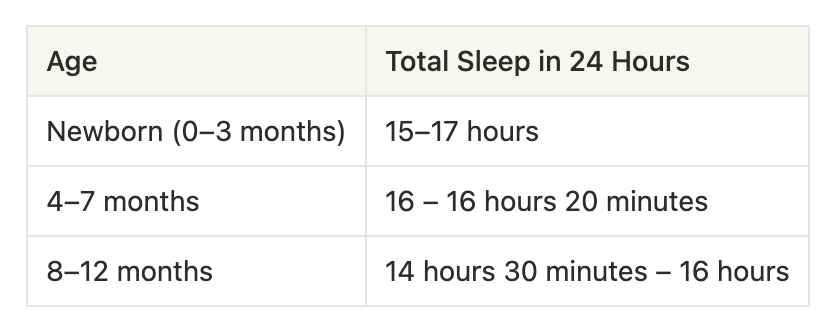
These totals include naps and nighttime sleep.
For many babies in the 4–12 month range, a healthy rhythm often looks like:
👉 12 hours at night plus daytime naps.
That’s why building a strong daytime structure matters so much.
Baby Sleep Schedule by Age (0–12 Months)
Here’s how a typical baby sleep schedule by age evolves throughout the first year.
Every baby is different, but their biological sleep patterns follow similar stages in the first year.
0–6 Weeks: The Gentle Start
At this stage babies are still adjusting to life outside the womb.
Sleep tends to be:
- very frequent
- short (60–90 minutes)
- spread throughout day and night
Newborns may sleep ~17 hours per day, but often in short stretches.
Typical rhythm:
Wake window: 75–90 minutes
Naps: 3–5 naps per day
Bedtime: flexible
The goal is not a strict schedule.
It’s gentle structure:
- consistent morning wake-up window
- lots of daylight during the day
- calm evening wind-down
- frequent feeding
These cues slowly help babies begin distinguishing day from night.
6–12 Weeks: Building Rhythm
This is where things start to shift.
Your baby’s circadian rhythm begins developing, and patterns start forming.
This is when routines begin to matter.
Typical rhythm:
Wake window: 90 minutes
Naps: 3–4 naps per day
Bedtime: usually between 7–7:30 PM
Some babies also begin sleeping longer stretches at night.
Consistency during the day now starts to influence night sleep.
3–6 Months: Creating Structure
This is where sleep becomes much more predictable.
Sleep cycles mature, and babies start consolidating more sleep overnight.
Typical rhythm:
Wake window: 2 - 2.5 hours
Naps: 2–3 naps
Night sleep: up to 12 hours
Bedtime: usually between 7–7:30 PM
This stage is where wake windows become extremely important.
When they’re off, babies become overtired quickly.
If you want to get this right, I’ve broken down the exact wake windows by age here → Baby Wake Windows by Age (0–12 Months)
6–9 Months: Predictable Days
By now many babies transition to 2 naps.
Typical rhythm:
Wake window: 2–3 hours
Naps: 2 naps
Night sleep: up to 12 hours
With the right structure, many babies at this stage begin sleeping 12 hours at night consistently.
9–12 Months: Two-Nap Rhythm
Toward the end of the first year, some babies begin transitioning toward a one-nap schedule, although many still follow a two-nap rhythm for a while.
Wake windows increase to 3–4 hours depending on the time of day.
Typical rhythm:
Wake window: 3 hours
Naps: 1-2 naps
Night sleep: up to 12 hours
At this stage days become very predictable when naps and bedtime stay consistent.
Travelling with your baby?
Same schedule, different postcode.
Planning to travel with your baby and worried about keeping the schedule on track? Flights, time zones, and new sleep environments don't have to derail everything. I cover the exact timezone reset strategy, how to pack the sleep environment, and how to handle night wakings away from home.
Get the Baby Travel Sleep Guide →Free guide
Want your baby sleeping 12 hours a night?
Download my free guide — the simple structure I used to help my son sleep longer, nap better, and eat well during the day. No cry-it-out. No rigid schedules.
Get the free guide →Why Many Baby Sleep Schedules Fall Apart

The biggest mistake parents make is focusing only on night sleep.
But night sleep is the result of the entire day.
Sleep struggles often come from:
- wake windows that are too long or too short
- random nap timing
- inconsistent bedtime
- feeding that doesn’t align with sleep
When these are off, babies become overtired.
Overtiredness increases cortisol, which leads to more waking, not less.
This is why quick tips don’t fix sleep.
The Missing Piece: A Daily Rhythm
What actually improves baby sleep is when the entire day starts working together.
A strong baby routine by age connects:
- wake windows
- naps
- feeding times
- bedtime
- circadian biology
When these align:
- naps become more predictable
- babies fall asleep easier
- night sleep naturally lengthens
Most sleep struggles come down to timing. If your days feel off or naps are inconsistent, start here → Baby Wake Windows by Age (0–12 Months)
Bringing It All Together
If your baby’s sleep feels chaotic, it’s usually not because you’re doing something wrong.
It’s because no one has shown you how baby sleep actually works.
Once you understand:
- how sleep develops
- how wake windows shape the day
- how circadian rhythm drives night sleep
- how structure creates predictability
everything starts to click.
Because calm days and 12-hour nights don’t happen by chance.
They happen when your baby’s day finally starts working together.
Want the foundation that makes everything easier?
The Baby Sleep Blueprint is the complete system — wake windows, nap timing, feeding rhythm, bedtime routine — all working together. Age by age, week by week.
Get instant access → 14-day money-back guarantee · Lifetime access · Start tonight
Common Questions About Baby Sleep Schedules
When should babies start following a sleep schedule?
Gentle structure can start from day one.
Simple cues like daylight during the day, darkness at night, and age-appropriate wake windows help babies develop their circadian rhythm.
By 6–12 weeks, this begins forming into a predictable rhythm.
Can babies sleep 12 hours at night?
Yes. Many babies can sleep 12 hours at night once their naps, wake windows, and feeding are aligned.
In earlier months, this may include one night feed or a dream feed. As rhythms mature, many babies transition to full uninterrupted nights.
Why does my baby's sleep schedule keep changing?
Because your baby is developing.
Wake windows lengthen, naps decrease, and sleep consolidates as the brain matures. Adjusting your baby’s routine to these changes is key to maintaining good sleep.
