
Baby Wake Windows by Age (0–12 Months): How to Get the Timing Right

If your baby fights naps, wakes after 30 minutes, or turns into a different human by bedtime…
It’s not random.
It’s timing.
More specifically:
wake windows.
Because when your baby stays awake too long or not long enough, sleep starts to fall apart fast.
Short naps. Night wakings. Bedtime battles.
Not because your baby is a bad sleeper.
But because their biology is out of sync.
What Are Wake Windows (And Why They Matter)
Wake windows are the amount of time your baby can comfortably stay awake between sleeps.
They’re not based on guesswork.
And they’re definitely not about “keeping your baby awake so they sleep better.”
They’re based on how your baby builds sleep pressure.
When wake windows are right:
- naps get longer
- bedtime gets easier
- nights get more consolidated
When they’re off:
- cortisol rises
- baby gets overtired
- sleep becomes fragmented
The Part Most Parents Miss
Wake windows don’t work on their own.
They only work when they’re part of a full daily rhythm.
When you combine wake windows with a proper daily structure, everything starts to click into place.
Naps get longer. Nights get calmer. Your baby stops fighting sleep.
If you want to see exactly how this looks across the full day:
👉 Read this next: Baby Sleep Schedule by Age (0–12 Months)
Baby Wake Windows by Age (0–12 Months)
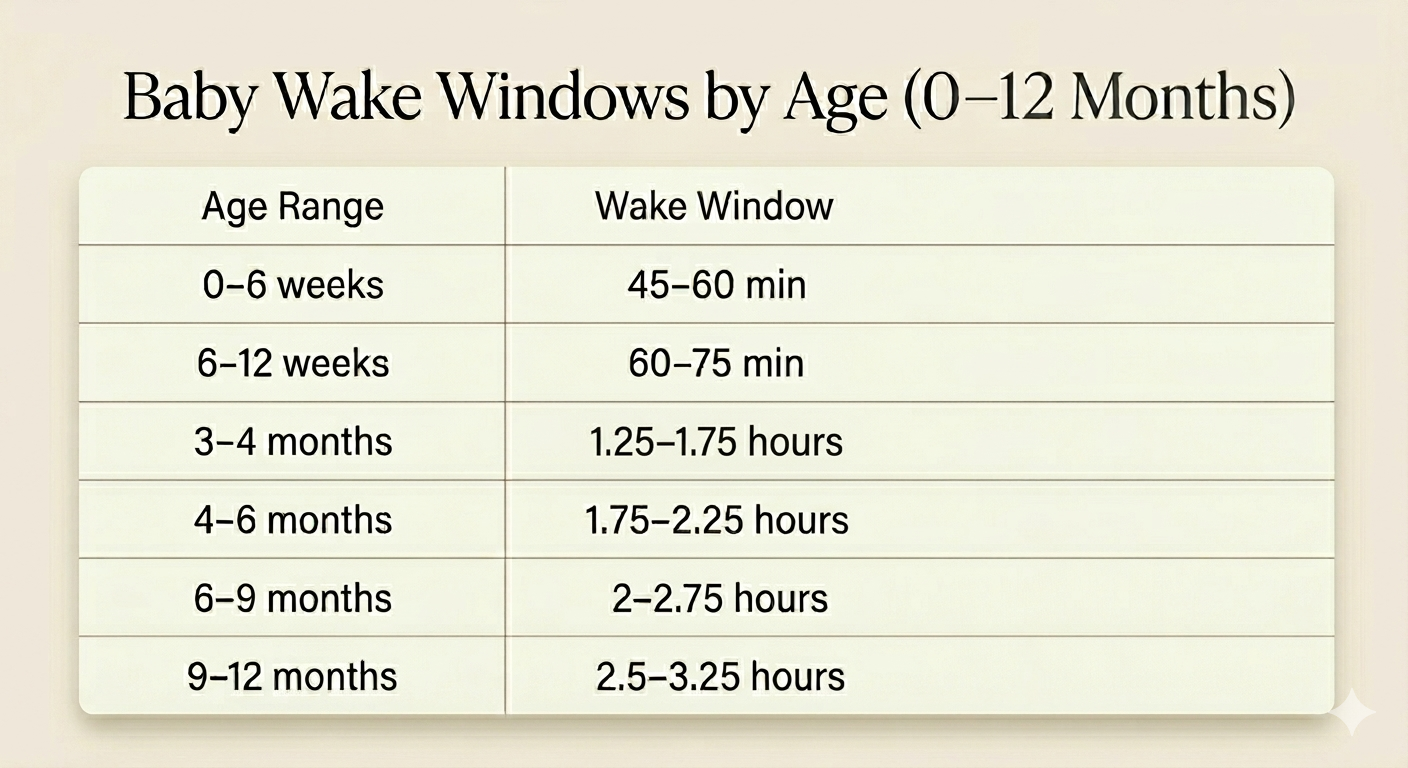
These are realistic, biology-based ranges.
Not rigid rules
But not random either.
They give you a structure to work with, so your baby doesn’t drift into overtiredness or undertiredness.
0–6 Weeks
45–60 minutes
Newborns get tired fast.
Overtiredness builds quickly at this stage.
Short, gentle awake periods work best here.
6–12 Weeks
60–75 minutes (occasionally up to 90)
This is where a gentle rhythm starts forming.
You’ll start to see slightly longer awake time, but pushing too far here is one of the fastest ways to disrupt naps.
3–4 Months
75–110 minutes (1.25–1.75 hours)
Sleep is maturing here.
This is also where many parents stretch wake windows too aggressively, which leads to overtiredness and fragmented naps.
4–6 Months
1.75–2.25 hours
This is where structure starts working in your favor.
When wake windows are dialed in, naps begin to lengthen and the day becomes more predictable.
6–9 Months
2–2.75 hours
Your baby can now handle longer awake time.
This is where a consistent routine really starts paying off.
9–12 Months
2.5–3.25 hours
Wake windows stretch further.
Too short → undertired → nap resistance
Too long → overtired → night disruptions
Balance here is key.
How to Know If Wake Windows Are Off
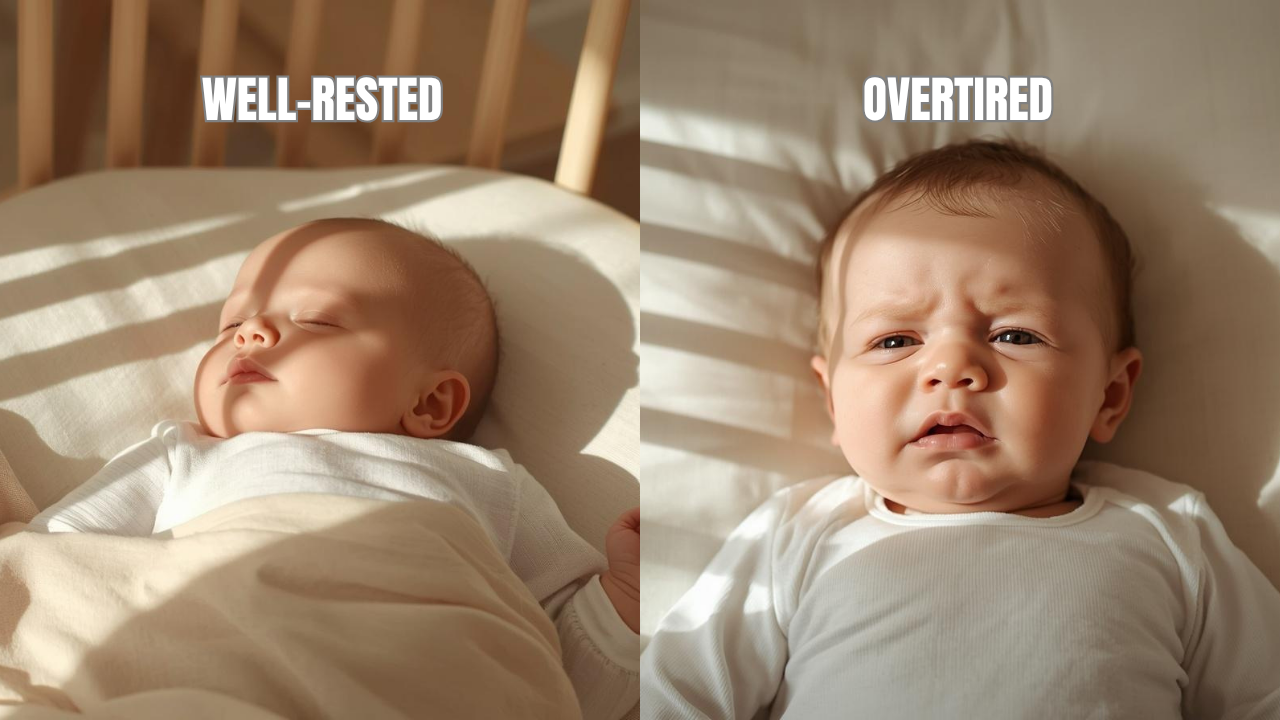
Wake Window Too Short
Your baby:
- fights naps
- takes forever to fall asleep
- wakes after 20–30 minutes
- seems fine… then crashes later
Wake Window Too Long
Your baby:
- gets fussy before sleep
- struggles to settle
- wakes more at night
- wakes early in the morning
This is overtiredness.
And it’s one of the biggest reasons sleep falls apart.
Free guide
Understand why your baby wakes — and what to do about it.
Baby Sleep Cycles 101 explains what's actually happening inside your baby's body at night — so you stop guessing and start working with their biology.
Get the free guide →Why This Impacts Night Sleep So Much

Night sleep doesn’t start at bedtime.
It’s built across the entire day.
If wake windows are off:
- naps become inconsistent
- sleep pressure is uneven
- cortisol rises
And then nights fall apart.
This is why you need to build a baby sleep schedule that works together as a system, not just fix random pieces.
If you want to see how to structure your baby’s full day so nights actually become easier:
👉 Read this next: Baby Sleep Schedule by Age (0–12 Months)
And This Is Where Most Moms Get Stuck
You know wake windows matter.
But:
- how do you adjust them?
- how do they fit with feeding?
- what does the full day actually look like?
That’s where things stay inconsistent.
Travelling with your baby?
Wake windows don't have to fall apart when you travel.
A new time zone shifts your baby's entire internal clock, and wake windows that worked perfectly at home suddenly feel completely off. I cover exactly how to reset wake windows and the full routine after a time zone shift — usually within two to three days.
Get the Baby Travel Sleep Guide →Want to Turn This Into 12-Hour Nights?
Wake windows are just one piece.
They only work when everything else is aligned:
full feeds
naps
bedtime
daily rhythm
This is where most parents get stuck.
They try to fix one piece, but sleep only works when the whole system is working together.
If you want to understand how to structure your baby’s full day so sleep actually becomes easier:
👉 Read this next: Baby Sleep Schedule by Age (0–12 Months)
Want the foundation that makes everything easier?
The Baby Sleep Blueprint is the complete system — wake windows, nap timing, feeding rhythm, bedtime routine — all working together. Age by age, week by week.
Get instant access → 14-day money-back guarantee · Lifetime access · Start tonightCommon Questions About Wake Windows
Do wake windows need to be exact?
No. Wake windows are ranges, not exact minutes.
Your baby isn’t a clock, and forcing precision usually backfires.
What matters is reading your baby within that range and adjusting based on how they respond.
Should wake windows be the same all day?
No. Wake windows typically build throughout the day.
The last wake window before bedtime is usually the longest because sleep pressure has been building all day.
If this one is too short, bedtime becomes a fight.
Do wake windows change suddenly?
No. Wake windows typically build throughout the day.
The last wake window before bedtime is usually the longest because sleep pressure has been building all day.
If this one is too short, bedtime becomes a fight.
